

Croatia Holidays
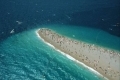
Geographical position: Croatia located in the heart of Europe on the beautiful Adriatic coast bordering Italy, Slovenia and Hungary. Croatia, the country of more than 1,185 islands, islets and reefs, including 67 uninhabited, extends from the foothills of the Julian Alps in the north-west and the Pannonian Plain in the east, over the Dinara mountain range in its central region, to the Adriatic coast in the south.
Area of Croatia is 56,542 km2, including 4,058 km of island, islet and reef coastline, with an additional 31,067 km2 of territorial waters. The largest islands of Croatia are Krk and Cres.
Time zone: GMT plus one hour in winter and GMT plus two in summer.
Climate in Croatia: Northern Croatia has a continental climate; Central Croatia has a semi-highland and highland climate, while the Croatian coast has a Mediterranean climate. Winter temperatures range from -1 to 30°C in the continental region, -5 to 0°C in the mountain region and 5 to 10°C in the coastal region. Summer temperatures range from 22 to 26°C in the continental region, 15 to 20°C in the mountain region and 26 to 30°C in the coastal region.
Capital of Croatia: Zagreb (780 thousand inhabitants) - the administrative, cultural, academic and communication centre of the country.
Population in Croatia is about 3.9 million (2021 census). The majority of the population are Croats. National minorities include Serbs, Moslems, Slovenes, Italians, Hungarians, Czechs, Slovaks, and others.
Official language in Croatia is Croatian language and Latin alphabet.
Religions in Croatia: the majority of the population are Roman Catholics, and in addition there are a number of those of Orthodox faith, as well as Muslims, and Christians of other denominations.
Currency in Croatia is the euro (€). Croatia adopted the euro on 1 January 2023, and it has been the sole legal tender since 15 January 2023, replacing the kuna at the fixed rate of 7.53450 kuna per euro. Kuna banknotes can still be exchanged for euro at the Croatian National Bank (Hrvatska narodna banka) without a time limit. (Reviewed October 2026 against the European Central Bank’s changeover guidance.)
Foreign currencies can be exchanged at banks, exchange offices, post offices and at most tourist agencies, hotels and camping grounds. Banking hours are 7 a.m. to 7 p.m. from Monday to Friday. On Saturdays banks are open until 1 p.m. In the larger cities some banks are also open on Sundays.
Working hours: Shops and department stores are open between 8 a.m. and 8 p.m., and on Saturdays from 8 a.m. to 2 p.m., or to 3 p.m. A smaller number of stores close between noon and 4 p.m. Many stores are also open on Sundays, especially in the summer, and a smaller number in the larger cities are open 24 hours a day. Public services and companies usually work from 8.30 a.m. to 4.30 p.m. from Monday to Friday.
Electricity: Electrical current is 230 volts, 50Hz. European style round, two-pin plugs are standard.
Communications: The international access code for Croatia is +385. The outgoing code is 00 followed by the relevant country code. The city code for Zagreb is (0)1 and (0)20 for Dubrovnik. Public phones take phone cards, which can be bought in post offices and hotels. GSM operators have active roaming agreements with most international networks, and cover most of the country. Internet cafes are available in the larger towns and cities.
Tipping: In tourist or upmarket restaurants a tip of 10% will be appreciated, but otherwise it is usual to round up the bill if the service has been good unless a service charge has already been added. Tour guides expect to be tipped. Most services receive a small tip by rounding up the bill.
Safety: Most visits to Croatia are trouble-free, and there is no particular threat of terrorism. Busy tourist areas are prone to petty theft. Outside the normal tourist routes travellers should be aware that unexploded mines might remain, particularly in Eastern Slavonia and the former Krajina.
Medical service: There are hospitals and clinics in all larger cities and first aid clinics and pharmacies in all places. EU visitors can use the European Health Insurance Card (EHIC) for medically necessary state healthcare; visitors from countries without a health-care agreement with Croatia are charged directly according to the price list. For patients whose lives are in danger, there is emergency transport by air (helicopter) or sea (speedboat).
Travel documentation: Passport or some other internationally recognized identification document. Croatia is part of the Schengen area and of the European Union: visitors from countries requiring a visa may stay up to 90 days in any 180-day period, while EU citizens may travel and reside freely. (Reviewed October 2026.)
Customs regulations of the Republic of Croatia follow the rules of the European Union, of which Croatia has been a member since 2013. Cash of €10,000 or more (or the equivalent in another currency) must be declared to customs when entering or leaving the EU through Croatia; when moving €10,000 or more between EU countries, the details must be provided to Croatian customs if a check asks for them. Dogs, cats and ferrets travelling across EU borders need an EU pet passport with a valid rabies vaccination — check the current pet-travel rules before you go. Non-EU residents may be able to claim a VAT refund on goods bought in Croatia and exported in their luggage — ask the retailer for the paperwork at purchase. (Reviewed October 2026 against the Croatian Customs Administration’s passenger guidance.)